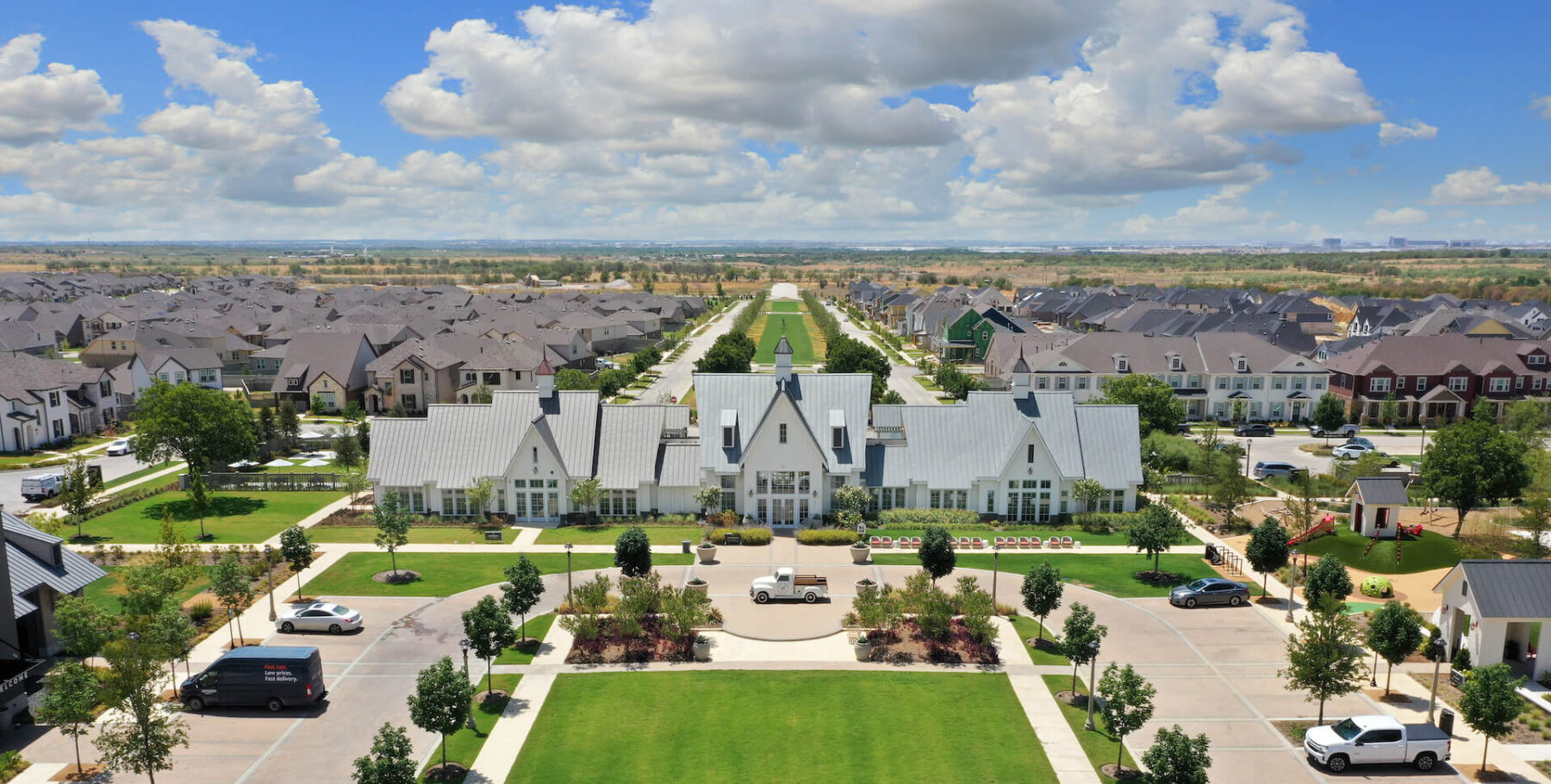
By Brian Carlock, Senior Vice President, Hillwood Communities
As a member of the Urban Land Institute (ULI), I had the privilege of recently attending the ULI national conference in Toronto, where I had the opportunity to discuss the exciting advancements happening in residential housing. One particularly remarkable innovation that we explored was the development of 3D-printed homes, a groundbreaking approach to home building.
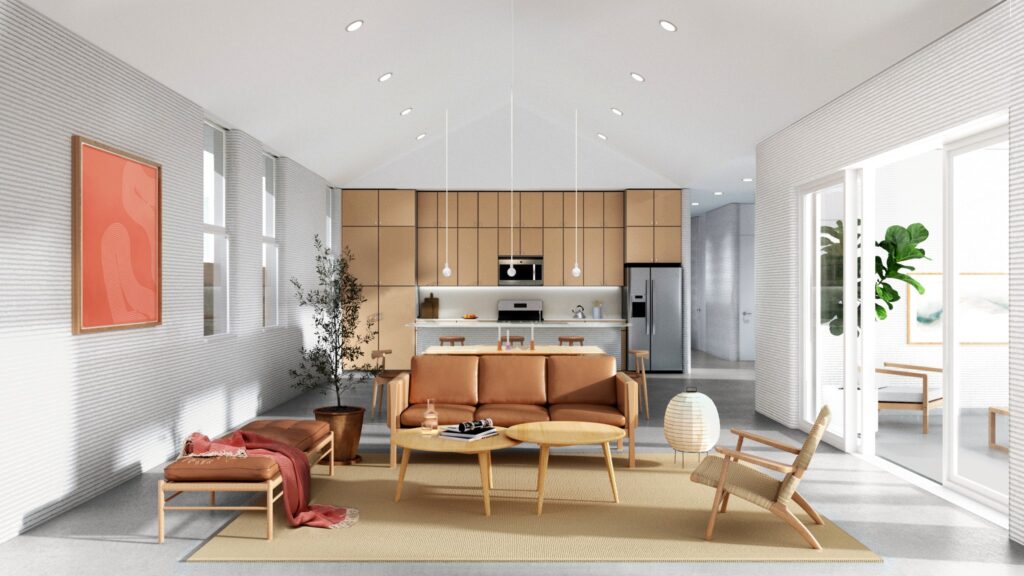
If you are seeking an affordable, sustainable, and innovative housing solution, you should definitely take a look at the world’s largest community of 3D-printed homes located in Hillwood’s master-planned community Wolf Ranch in Georgetown, Texas. This groundbreaking project is a collaborative effort between ICON, a pioneering construction technology company in large-scale 3D printing; Lennar, one of the nation’s leading homebuilders; BIG-Bjarke Ingels Group, an architectural firm; and Hillwood Communities, a renowned real estate developer.
The community of 3D-printed homes in Wolf Ranch, named The Genesis Collection, will comprise 100 single-family houses offering eight different floor plans ranging from 1,575 to 2,112 square feet. Construction is well underway with a fleet of ICON’s Vulcan robotic construction systems and the first homes available for purchase. This innovative approach to home building not only provides sustainable and affordable housing options but also represents a significant step forward in revolutionizing the construction industry and maintaining home affordability in the Austin, Texas area.
What exactly are 3D-printed homes?
ICON’s 3D-printed homes are houses built using a robotic construction system that prints the entire wall system of the home with a material it developed called Lavacrete. This proprietary cement-based material offers exceptional strength and durability, surpassing building code requirements. The printing process significantly reduces waste, saves time, requires less labor, and provides greater design freedom and customization options.
What are the benefits of 3D-printed homes?
- Efficiency & Durability: Inherently strong, resilient, and more energy-efficient, the Genesis Collection at Wolf Ranch is built using advanced materials, engineering, and 3D robotics. Advanced materials and airtight building envelopes reduce temperature fluctuations creating incredibly comfortable living spaces. Additionally, the wall systems are delivered with speed and precision, thus shortening the construction timeline
- Sustainably Built: With precise robotic construction, the wall systems are delivered with extreme accuracy and reduced waste. Powered by the Sun. Each home is equipped with highly efficient all-weather photovoltaic solar panels. Standing Seam Metal Roof. Metal Roofs are durable, energy-efficient, fire-resistant, and last longer than traditional roofs.
- High-performance, innovative homes with style: These 3D-printed homes embody cutting-edge technology and design trends within the housing industry. Each of these 3D-printed homes beautifully captures the essence of contemporary Texas ranch-style aesthetics. This feat was accomplished by the renowned architectural firm BIG-Bjarke Ingels Group. Along with their stylish design, each new home also comes equipped with smart home features and amenities that enhance comfort and convenience.
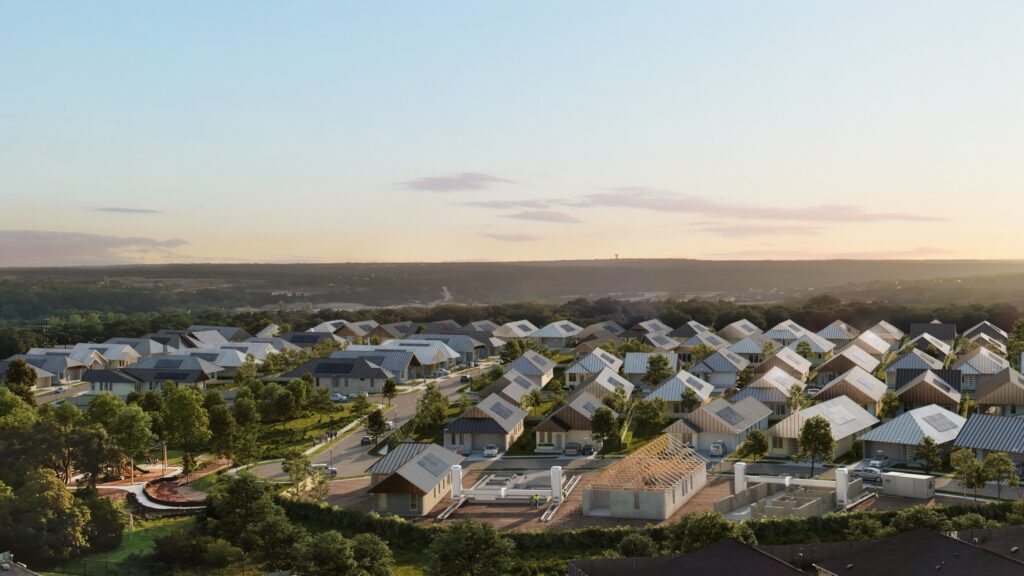
Hillwood Communities is excited to welcome ICON/Lennar and these futuristic new homes to our Wolf Ranch community in Georgetown. Wolf Ranch is a 1,120-acre development that offers a wide range of home styles, builders, amenities, and experiences tailored to residents of all ages and lifestyles. Nestled alongside the scenic San Gabriel River, Wolf Ranch serves as Georgetown’s very own Texas Hill Country oasis. It seamlessly combines serene natural settings with a vibrant community atmosphere.
For more information and updates on the 3D-printed homes, please visit https://www.iconbuild.com/wolfranch. You can also follow ICON on social media to stay connected with the latest news and developments regarding their projects.
It’s no longer sufficient to simply have a place to live—homeowners want a real sense of community, especially after the isolation brought on by the COVID-19 pandemic. A desire to connect with others is one of the driving forces behind master-planned communities’ surging popularity.
What Is a Master-Planned Community?
A master-planned community, or MPC, is a residential development that is carefully designed for convenient living and connectedness among neighbors. These communities offer homeowners numerous amenities—far more than you’ll find in a typical neighborhood. While the first planned communities were largely cookie-cutter developments built around golf courses or lakes, MPCs are now frequently designed to accommodate specific lifestyles.
Some of the hallmarks of modern MPCs include:
- Thoughtful design to minimize through traffic
- Highly walkable layouts
- Plenty of green space
- Wide array of amenities
- A strong sense of community among residents
Master-planned communities are great when you’re looking for a place to not only live, but to truly belong.
Master-Planned Community Vs. Neighborhood
According to data from 2017, about 52% of US households describe their neighborhood as suburban. However, a traditional suburban neighborhood isn’t the same as a planned community.
Living in Traditional Neighborhoods
Traditional neighborhoods are subdivisions that contain houses. Any businesses or amenities that arrive usually do so after the neighborhood has been established, which means the resulting layout ends up being a bit random.
In a regular neighborhood, your obligations typically extend only to your own home. The community as a whole isn’t necessarily anyone’s responsibility, making it a bit disjointed.
Living in a Master-Planned Community
On the other hand, a master-planned community is carefully designed ahead of time. Amenities, shops, scenic areas, and the like are all planned into the initial design, all with the end goal of creating a convenient and cohesive living experience.
It doesn’t stop at convenience, though. Community events, premium amenities, and communal spaces characterize most MPCs, offering many opportunities to share experiences, connect with your neighbors, and develop long-lasting friendships.
At Hillwood Communities, we design each of our neighborhoods to accommodate our residents’ interests and lifestyles. For example, Harvest by Hillwood in Argyle/Northlake, TX is an agrihood perfect for those who desire to live a farm-to-table lifestyle, have their own garden plot, and work in the community garden. Union Park by Hillwood in Little Elm, TX with a Fitness Park, Exploration Park, Bark Park, Food Truck Park, multiple pools, and miles of walking trails, is designed with those who prioritize the outdoors and physical activity.
Why Live in a Master-Planned Community?
Why live in one of our master-planned communities? Below are just a few of the features that set our communities apart.
Award-Winning Lifestyle Programs
Are you into gardening? Crafting? Wine-tasting? Our award-winning lifestyle programs at Hillwood’s Live Smart communities offer more than 300 events for homeowners to participate in and get to know each other. These events include educational workshops, kids events, movie nights, concerts, teen events, community-wide parties, game nights, and much more.
Small-Town Living with City Conveniences
Our communities are located outside of the big city center, but are still within easy driving distance of downtown. Residents can enjoy the charms of small-town living without sacrificing the conveniences of the city.
Fabulous Amenities
Our master-planned communities contain fantastic amenities for homeowners to enjoy. Some of the amenities and common areas we offer include
- Fitness centers
- Swimming pools
- Catch-and-release fishing ponds
- Hiking trails
- Community gardens and farms
- Sports Courts
- Outdoor Kitchens
- Game Rooms
- Co-Working Spaces
- Dog Parks
- Food Truck Parks
- Splash Pads
- Event Venues
- Outdoor workout facilities
- Coffee Shops
- Playgrounds
- Sports Fields
With such a wide range of amenities, you’ll never run out of fun things to do!
Commitment to Quality Education
Hillwood is committed to providing quality education for families in our neighborhoods. That’s why we locate our masterplans within desirable school districts. We also work with the districts to build elementary schools within the boundaries of the community itself, to maximize convenience and community involvement.
Beautiful Developments for Active Seniors
Our communities contain homes to suit virtually every budget and stage of life. Our Union Park by Hillwood community even has a Del Webb active adult section designed for residents aged 55 and up. This neighborhood has special amenities built just for active adults to enjoy and the homes have future-proof features that make it easy for residents to age in place.
Find the Hillwood Community for You
At Hillwood Communities, we are committed to fostering a true sense of community in each of our masterplans. To learn more, take a look at our communities or contact us today.
Today’s newest home interior trends are bold, exciting, and put a modern twist on classic decor ideas. If you are looking to update your home with new furniture or accessories this year, let these trends in home design inform your project.
Houseplants
Perhaps a result of the pandemic, houseplants are big in home design. Though many people have at least one houseplant, they have become increasingly popular in the last few years. The current fad is to have as many of them as possible, at least in one area, to create a mini jungle of sorts. The design gives reference to home trends in the United States in the 1960s and 70s, with a modern twist on the pots and the plants themselves.
Elemental Accessories
Speaking of the 1970s, wicker and rattan are making a huge comeback. These nature-inspired, elemental materials can be used in many different ways to accent a space, or as the primary furniture that anchors a room.
Natural stone remains a mainstay as well, making it a great option for flooring, backsplashes, countertops, and more.
Unique Furniture
Unique and vintage furniture is a leader of current trends in home design as well. Using furniture as a decoration, rather than as a necessity, has forced designers to get creative. It isn’t uncommon to see interesting or asymmetrical shapes for couches, chairs, and coffee tables.
A lot of the material being used in this furniture comes from renewable or sustainable resources, which is not only popular but essential for our changing environmental landscape. These new materials, such as bamboo, concrete, and cotton, give the furniture an unexpected quality.
Nostalgic Pieces
In the spirit of eco-friendly decor, new interior design trends are focusing on vintage or pre-owned pieces. A lot of the trends from mid-century homes are resurfacing, so it is easy to find vintage furniture that fits current trends. The style is nestled in nostalgia and allows homeowners and guests to take comfort in simpler times.
Maximalist Decor
Though minimalism will always be trendy in some form or another, maximalism has been taking the front seat recently. Rather than depriving one’s home of accessories, this style encourages lots of color and a significant number of accents. Mixing large and small pieces only adds to the ambiance. This style does not have to be mutually exclusive to the other trends on this list. In fact, rattan, wicker, and unique furniture are all hallmarks of maximalist design.
Personalized Outdoor Living Spaces
Up until a few years ago, outdoor furniture options were relatively limited. A lot of what was available was manufactured for durability, making it more utilitarian than fashionable. In recent years, experts have developed materials that can be both weather-proof and attractive, allowing families to make their outdoor spaces more personal to their unique taste.
A lot of the wicker and rattan trends stand true for outdoor spaces as well. Outdoor tables and chairs made of wicker are not uncommon and help to bring the elemental theme outside. What’s more, these natural materials blend seamlessly with the environment, making them an attractive option.
Smart Home Features
Smart home appliances such as Ring doorbells and the Amazon Echo Show have been growing in popularity, and in 2021 they are ubiquitous. No matter what the indoor aesthetic, many people are opting to install smart home devices. There are many perks to these appliances, many of which can appeal to almost anyone. They include:
- Better safety and home security
- Easy access to lights, heating and cooling systems, and electronics
- Better control over child safety features
- Peace of mind
Explore Hillwood Communities
Our neighborhoods seek to foster a sense of community while still offering residents privacy and ways to personalize their homes. Our meticulously designed amenities give homeowners many opportunities to engage and form bonds with their neighbors. With nine master-planned communities throughout Texas, there is a Hillwood community for everyone. For more information, browse our website or contact us today.
Some of the most common questions hopeful homebuyers ask before looking at available homes are, “How much house can I afford?” or “How much money do you need to make to buy a house?” If you are asking yourself these questions, it’s vital to consider your long-term earning potential and the long-term cost of ownership of the house you want to purchase. Hillwood Communities wants to provide you with the information you need to buy the home you want.
Can I Afford to Buy a House?
A common question among first-time homebuyers is “How much money should you make to buy a house?” According to hsh.com, you should make just under $64,000 per year to be able to afford a home at the median price of $269,900 in the Dallas area. Of course, there’s no hard and fast rule here but typically, employment and steady income are basic requirements when deciding if you’re ready to become a homeowner.
Other important pieces of data to look at are your debts, your credit score, and how much money you have in savings. What is your debt-to-income ratio? If you already have student loans, a car note, and credit card debt, can you afford to add a house payment and the other expenses that go with homeownership? What about your credit rating? If you have a spotty history of paying your bills, you may find it difficult to get a home loan. Finally, how much money do you have in savings? Most mortgages require some form of down payment and it’s crucial to have some money saved to cover other expenses that may arise with your new home.
How Much Mortgage Can I Afford in Texas?
There are a few formulas you can use to answer the question, “How much home can I afford in Texas?” The basic rule of thumb is that your housing costs should not account for more than 28% of your gross monthly income, and total debts should not be more than 36%. Our online mortgage calculator will help you determine what mortgage payment you can afford based on your current debts and your current salary.
If you are still asking, “What property can I afford?” remember that monthly mortgage payments typically include more than just the amount to pay off the home loan.
Part of the cost of owning a home is paying annual property taxes and homeowner’s insurance. Many people choose to make monthly payments towards their taxes and insurance along with their home loan payments. The tax and insurance payments are put in escrow and then paid on an annual basis to the insurance company and taxing authority on behalf of the homeowner. If you do it this way, each monthly payment you make will include portions that go toward the loan’s principal amount, accrued interest, taxes, and your homeowner’s insurance (PITI).
Many mortgage calculators include PITI when calculating house budget based on salary and some let you choose whether or not to include taxes and insurance. Of course, even if you choose not to escrow taxes and insurance, you still have to pay them.
Affording Texas Mortgage Payments
In 2021, the average mortgage payment for a Texas home is about $1,179.
Your down payment plays a big role in determining your mortgage payment. The larger your down payment is, the less there will be remaining from the loan principal, so your monthly payments will be smaller than they would if you only paid the minimum down payment amount. On average, Texas homebuyers in 2021 will pay about 12% of the home market price in their down payments. Your down payment amount will be very important when you create a preliminary house budget based on salary and your other financial obligations.
When you’re ready to buy, investigate different types of loans, including those for first-time homebuyers. For example, a Veterans’ Association loan may offer zero down payment if you qualify. You could also qualify for a Federal Housing Association loan that only requires a 10% down payment. USDA loans are ideal for low-income homebuyers and offer zero down payment to qualified borrowers. Instead of just asking yourself, “What house can I afford?” start reviewing your options for financing, especially if you are a first-time buyer. Depending on your eligibility, you may be able to afford more than you think.
Other Costs To Consider
Once you have a general idea of how much you need to buy a house in Texas, consider a few other costs that are likely to arise during and after the purchasing process, including:
- Property taxes. Your property taxes in Texas will increase as your home’s value increases.
- Homeowners’ Association (HOA) fees. If you purchase a home in an area that has an HOA, you’ll need to account for these fees in your budget.
- Closing costs. You’ll face additional costs beyond your down payment when you sign your mortgage, including a loan origination fee, home inspection fee, and an appraisal.
These are just a few of the additional costs to consider when asking yourself, “How much house can I afford in Texas?”
Ready to Start the Home Buying Process?
The master-planned developments by Hillwood Communities are great places to live, whether you’re interested in buying a move-in ready home or building a new home on a spacious Texas homesite. We can help you find an affordable home that offers a stellar long-term cost of ownership. Contact us today to learn more about our communities and the homes we currently have available.
However, we also know the past year has been a unique one. COVID-19 may have you asking yourself, “Is now a good time to buy a house?”
According to Forbes, the pandemic has people prioritizing how they want to live more so than where they should live. With these concerns in mind, we offer this guide to help you decide when is the best time to buy a house, and more specifically, when is the best time of year to buy a house.
Buying in the Spring
It could be argued that the best time to buy a home is in the spring. You have comfortable temperatures, and the kids will have time to acclimate to their home well before the fall semester. However, the market is highly competitive in spring. This should not be a deal-breaker, but it does mean that you should have a clear idea of what you’re looking for and what your budget will allow. If you decide that spring is the best time of the year to buy a house for you, then you should be in a position to buy with confidence and an understanding that you may have to make sacrifices to stay competitive.
Buying in the Summer
For many, summer is the time to buy a house, and here’s why: inventory is usually good because sellers want to get moved before school starts, and if their home hasn’t sold yet, they are motivated and will typically lower their prices. Sellers are searching for that sweet spot between earning a profit and appealing to the greatest number of buyers, which results in a win for everybody. It’s true that maybe a seller doesn’t earn quite the profit they’d hoped for, but it will still be a profit they can live with, and buyers can leverage this situation to their advantage.
Based on this strategy, the best month to buy a house might be August. This time of year seems to yield a reliable balance between supply and demand, a situation permitting the fairest transaction for all parties involved.
Buying in the Fall
How about the fall? Is it a good time to buy a house? For some, the answer may be yes. Particularly, families without children may find fall a good time to buy a house because not being tied to the school calendar frees them up to explore a quieter market. Given that the fall market is slower, buyers should not hesitate to negotiate. If you can, learn a seller’s motivation for selling in the fall, as it may reveal valuable information about the property in question.
Buying in the Winter
One huge reason to buy in winter that we may not have considered is quite simply that there are fewer competitors – by a lot – during this time of year. It is the most “buyer” of buyer’s markets available. In some states, it may seem that winter wouldn’t factor into the buying process because there isn’t much seasonal change. Texas is one of those states, so buying here means it’s always a good time to buy a house.
Other Factors to Consider
Of course, not all factors about when to buy a house can be divided neatly into a discussion of the four seasons. You have to consider where you are personally and what your ultimate goals for homeownership are. At the personal level, it becomes a question of when is a good time to buy a house versus when is the right time to buy a house. These are questions only you and those closest to you can answer.
The Housing Market and the Economy
The COVID pandemic has transformed the housing market across the country. Depending on your state’s economy, there is likely a low-interest rate waiting for you. The recession is tragic in that it is affecting the livelihoods of all Americans, but one way to jumpstart it is to take advantage of lower interest rates and slashed down payment requirements. The best time of the year to buy a house is during years when interest rates are low – like now.
Personal Readiness
Regardless of the economy, what matters most in your decision to buy a home is whether or not you are ready. When it comes to answering the question, “is now a good time to buy a house?”, only you can decide. Some things to consider:
- Have you budgeted for all aspects of the home, including mortgage, escrow, and insurance?
- Can you comfortably afford the down payment for the home you want? It may be worthwhile to consider waiting for the home you are dreaming about.
- Are you (and your family) ready to make a move from where you are to a new home?
Ultimately, it comes down to your own goals, personal timeline, and finances to know the best time to buy a home is for you.
When You’re Ready to Purchase a Home, Consider Hillwood Communities
If you’ve decided now is the time to purchase a home, consider Hillwood Communities. We believe in creating connections in neighborhoods and bringing people together. When it’s time to buy a house, remember that it’s more than brick-and-mortar; it’s the place you will build a life and call home. Contact us today to learn more.
Master Planned Communities are large residential communities, often suburban or rural, that include a broad offering of amenities for homeowners.
These master-planned neighborhoods differ from traditional housing subdivisions in that they typically offer homes from a number of home builders rather than just one or two and include a variety of lot and home sizes within a broad array of price ranges. As a result, master-planned communities tend to attract residents in every stage of life, from first-time homebuyers to established families, to empty nesters and retirees.
The Convenience of Amenities Inside & Outside The Community
An online search for the definition of a master-planned community yields the following from Bankrate.com:
“A master-planned community is a large-scale residential neighborhood with a large number of recreational and commercial amenities . . .”
Master-planned communities’ amenities tend to be what initially draw potential residents to these neighborhoods. Virtually all planned communities include recreational spaces such as swimming pools, green spaces, and paths for residents to enjoy. Schools are another important focus for master-planned neighborhoods and some have a public school from their district located on-site.
Location is also very important for master-planned development. Most Hillwood planned communities have easy freeway access, are close to shopping, dining, services, and entertainment, and are conveniently located within thirty miles of a major metropolitan area and within forty miles of a major airport.
In addition to traditional master-planned community amenities, Hillwood’s Live Smart communities offer even more. Harvest by Hillwood was created for residents with an appreciation for the farming heritage of its region of North Texas. In addition to parks, pools, and other amenities, Harvest homeowners who value farm-to-table produce have access to their own private plot in the community’s garden and can get help from an on-site farming expert.
Pecan Square by Hillwood has a technology focus. Every Pecan Square homeowner receives a Canopy technology bundle and has access to an on-site home automation professional for assistance with home tech needs.
Each of our five Live Smart communities have been constructed to conserve resources with water-wise landscaping and energy-efficient building principles. Centered around the enduring principles of connection, well-being, enrichment, stewardship, and convenience, these communities offer forward-thinking residents a sustainable and active lifestyle for the 21st century.
The lifestyle managers at our Live Smart properties schedule hundreds of fun, enriching activities each year for residents including fitness classes, community programs, parties, children’s activities and much more. Our common spaces are designed to encourage interactions and active play. These master-planned communities create the perfect environments for families to thrive, friendships to blossom, and neighbors to live life to the fullest.
Safety For You and Your Family
One of the benefits of master-planned communities is safety. Most planned housing communities are located in rural or suburban locations which tend to have lower crime rates overall so the risk of random crime in a planned community development is low.
Those who live in planned residential communities tend to know each other better than residents of other neighborhoods. The community events, walking trails, playgrounds, and other amenities make it easy to get to know your neighbors. When you live on the street with people you know and care about, it’s easy for neighbors to look out for each other.
A planned residential community typically has a limited number of access points in and out of the development, meaning that there is virtually no through traffic and the neighborhood streets tend to be less traveled and safer for kids.
Hillwood’s master-planned communities are created with safety in mind. Our Live Smart communities were specifically designed so that kids (and their parents) could explore and make new friends safely. This friendly neighborhood atmosphere and shared sense of community is the reason why so many families choose to buy a home in a Hillwood Communities property.
Investing In Your Future
Are master-planned communities good investments? Yes, they typically are. The value of homes in master-planned communities tend to be more stable because they are in good locations (that become even better with time), they are in attractive, well-maintained neighborhoods, and they have reputable schools. The real estate advisory company RCLCO found that homes in planned housing communities appreciate at a faster rate than other homes during a strong economy and lose less value in a slow economy.
What costs are associated with living in a master-planned development? When you live in a master-planned community, you will most likely have some expenses associated including homeowners’ association (HOA) dues. The HOA’s job is to take care of the communal areas of the community and in some communities, HOAs perform some functions to assist homeowners with their properties.
The HOA is responsible for operating and maintaining many community amenities, including swimming pools, ponds, fountains, green spaces, fitness facilities, event venues, playgrounds, and the landscaping in the communal areas. All homeowners in the community share these expenses when they pay their HOA dues.
On occasion, a larger expenditure may be necessary, such as resurfacing a swimming pool or replacing the roof of a building. This might require an assessment, which is a one-time charge that is divided among all members of the HOA.
Master-Planned Communities By Hillwood
If you’re interested in exploring homes within a master-planned community, we have a lot of great options for you. Our Dallas-Fort Worth Metroplex properties include communities in Argyle, Northlake, Celina, Little Elm, Melissa, and Lucas, Texas. We also have a wonderful community near the Austin area in Georgetown, Texas and another outside of Houston in Manvel, Texas. Each one of our communities has its own distinctive appeal and has been created with a sense of shared community in mind.
Here are the steps to take to make buying a home in Texas a reality for you:
- Make lists. What’s it like living in Texas? What style homes can I find in Texas? Where can I find the perfect home for me? Buying a house can be one of the most important decisions in your life, so don’t be afraid to make lists of everything on your mind. Get your family in on it, too.
- Begin the process early. Start looking at Texas homes now! The sooner you get going, the sooner you and your family will be moving in. We know that you want to find the home of your dreams, so why not start now exploring the styles that will make you and your family happy. A Texas master-planned community can be the perfect place for families to grow in neighborhoods that are wonderful to live in and explore.
- Figure out what you can afford. We know from experience that when you have an affordable mortgage payment, you can focus your attention on the important things in life like your partner and your children, instead of stressing about paying the bills. Homes in master planned communities in Texas can offer an excellent value for the dollar. In addition, your total property tax bill per dollar of home value is likely to be lower in a Texas master planned community than in many Texas cities.
- Research your financing options. There are many ways to finance new homes in Texas with both national and state-wide programs available. The Federal Housing Administration, US Department of Veteran Affairs, and USDA are all national programs that can help you find the right loan for you. If you’re a first-time home buyer, the Texas Department of Housing and Community Affairs has special first-time home buyer programs that can offer low interest rates and assistance with down payments and closing costs. Whether you are already living in Texas or buying a home in Texas from out of state, there is sure to be a program and mortgage lender that meets your needs!
- Get pre-approved. This is an exciting part of the process. Once you get pre-approved, this really gets your journey to homeownership moving. The pre-approval process can be as simple as providing your income, the amount in your savings account, credit score, and your investments.
- Find a Realtor. When buying a first home, a realtor is an invaluable asset. A local real estate agent is a partner who cheers for you and your family. A great realtor will work hard to get you moving into that new house as soon as possible.
- Revisit your list. Now that you have a better idea of what you can afford, you can go back to that list you and your family made earlier and see how those dreams can be built into a home. Having fun may not be the first thing that comes to mind when you think of buying a home, but don’t be afraid to be excited about your future.
- Time to make an offer! Once you have that specific home that you know is just right for you and your family, it’s time to make an offer. This step will include specifying how much you are willing to pay for the home, as well as other terms of the sale.
- Get a Home Inspection. A home inspector will check over the house from top to bottom and prepare a report of his or her findings. You don’t want any surprises after you’ve purchased your home.
- Apply for a Loan. If you’ve been pre-approved, this is the second part of the loan application process. If you have not already started the loan application process, start now! As a first time homebuyer make sure to review the title company, interest rate and mortgage payment.
- Close on the home. This is it – just make sure to account for closing cost! This is the moment you get the key to your new house. We know how exciting being part of a planned community in Texas is, and we’re always happy when another family can share this lifestyle as well. The pieces have all fallen into place, and it’s time to enjoy healthy living in a quality home.
Cost of Living in Texas
The median home price in Texas is $310,000, which is almost 10% lower than the national median. The average cost of living in Texas is 8.8% lower than the national average. This means the cost of groceries, health care, and transportation are all much lower than the national average. On top of all of that, there is no income tax!
Benefits of Living in Texas
There are so many wonderful benefits of living in Texas. Our economy is booming, and there are great educational systems here, including both quality public schools and some of the top public and private universities in the country. One of the benefits of a Texas master planned community is that we have strategically planned ways to draw people together and create strong relationships between neighbors. From the layout of the community itself to the shared values and interests, we know you will live healthy and safely in a new Texas home.
If you know what to do, buying a new home in Texas can be an exciting, rewarding experience that will start you on the path to creating a lifetime of happy memories. Once you have an idea of the area you are interested, be sure to check out the unique master-planned communities in Texas. Good luck and get started!